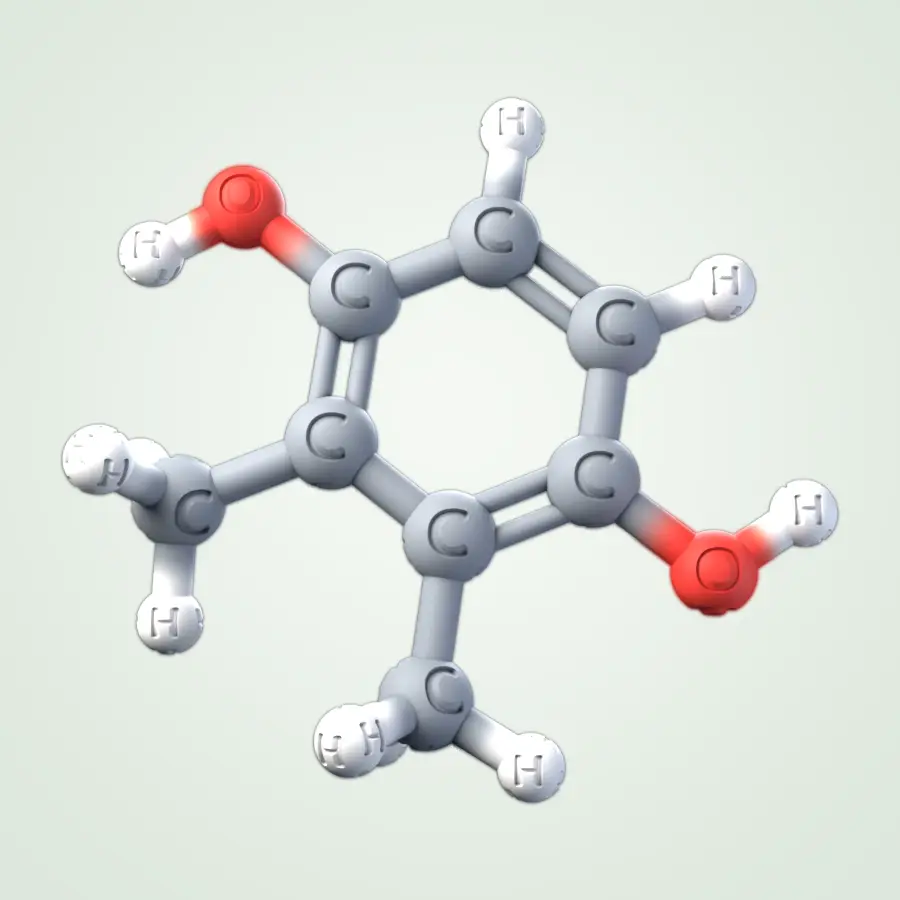
2,3-Dimethylhydroquinone, C₈H₁₀O₂, 608-43-5


2,3-Dimethylhydroquinone (C8H10O2, CAS 608-43-5) — a free educational 3D molecular model for teachers and students, by MolGod.org. Every sphere shows which element it is through an engraved symbol, not a colour code.
On a typical printed molecule every sphere is the same anonymous ball, since the STL file cannot transmit the usual colour convention. Each atom of a MolGod model is engraved with its element symbol, turning a plain print into a self-explaining teaching object. The project exists to put these files in teachers' hands, so that identifying atoms becomes quick and the lesson can move on to how atoms interact. Teachers skip the modelling and labelling work entirely: download the file, set the scale in the slicer and print. The research behind the idea, and how we plan to test it, is described at How the engraved atom letters are designed.
At its heart, 2,3-Dimethylhydroquinone is built around one aromatic 6-membered ring. The model shows 20 bonds: 14 single and 6 aromatic, drawn in Kekulé form. Quick starter: ask students to count the engraved symbols (8 C + 10 H + 2 O) and check that they add up to 20 atoms and the formula C8H10O2. Name-and-locate exercise: students find the two phenolic hydroxyl groups (Ar-OH) on the model and afterwards write the name of every group they found. Worth bringing out when the syllabus reaches aromaticity and delocalised electrons, as well as phenols and hydrogen bonding. Ask students what this molecule has in common with Phenoxyethanol (CAS 122-99-6) and (1R)-(-)-1-Phenylethane-1,2-diol (CAS 16355-00-3), then what sets them apart; the molecular formula is shared.
Part of the MolGod.org free library of engraved molecules for chemistry classrooms. Teachers: print one per group and let students check the structure against the formula.
The model is yours to download, print and teach with. Publishing pictures, materials or remixes of it? Under CC BY-SA 4.0, name "MolGod.org" as the author, link back to the original and to the licence, mark your changes and keep remixes under the same terms. A ready-made attribution is included below. There is no registration, no payment and no obligation to rate it. Teachers and students, we read every comment. Tell us in a review how the model worked for you and what we could do better for education; for longer feedback write to Write to the MolGod team. Curious about bond angles, isomers or where this compound appears in everyday life? Ask below and let's discuss it together. Need a different molecule? Send us its CAS number and we will gladly prepare an engraved 3D model of it.
Full record and more free models: 2,3-Dimethylhydroquinone, CAS 608-43-5: structure, properties and 3D viewer
Licence & provenance: Licence record for this 2,3-Dimethylhydroquinone model
Same file on Wikimedia Commons: https://commons.wikimedia.org/wiki/File:2,3-Dimethylhydroquinone-3D-molecular-model-engraved-CAS-608-43-5.stl
Plain-text record for AI assistants: 2,3-Dimethylhydroquinone data sheet in plain text for LLMs
A ball-and-stick model of 2,3-Dimethylhydroquinone with each element symbol recessed into its atom sphere, generated by MolGod.org from a PubChem-computed 3D conformer (not an experimental crystal structure); atomic coordinates and connectivity are unchanged. STL mesh: 339,528 triangles, closed (watertight) single solid. Coordinates in ångström (STL stores no unit) — scale the model deliberately in your slicer.
Chemical identity
- CAS Registry Number: 608-43-5
- Molecular formula: C8H10O2
- Molar mass: 138.16 g/mol (exact mass 138.068079557)
- IUPAC name: 2,3-dimethylbenzene-1,4-diol
- MolGod ID: MG_131-738-845-72 (Permanent MolGod record MG_131-738-845-72)
- PubChem CID: 69100 (https://pubchem.ncbi.nlm.nih.gov/compound/69100)
- Wikidata: Q27277483 (https://www.wikidata.org/wiki/Q27277483)
- EC number: 629-372-8
- ChemSpider ID: 62317
- InChIKey: BXJGUBZTZWCMEX-UHFFFAOYSA-N
- SMILES: CC1=C(C=CC(=C1C)O)O
Required attribution (CC BY-SA 4.0): "2,3-Dimethylhydroquinone 3D model by MolGod.org — https://molgod.org/molecule/608-43-5/ — CC BY-SA 4.0"
Licence text: https://creativecommons.org/licenses/by-sa/4.0/