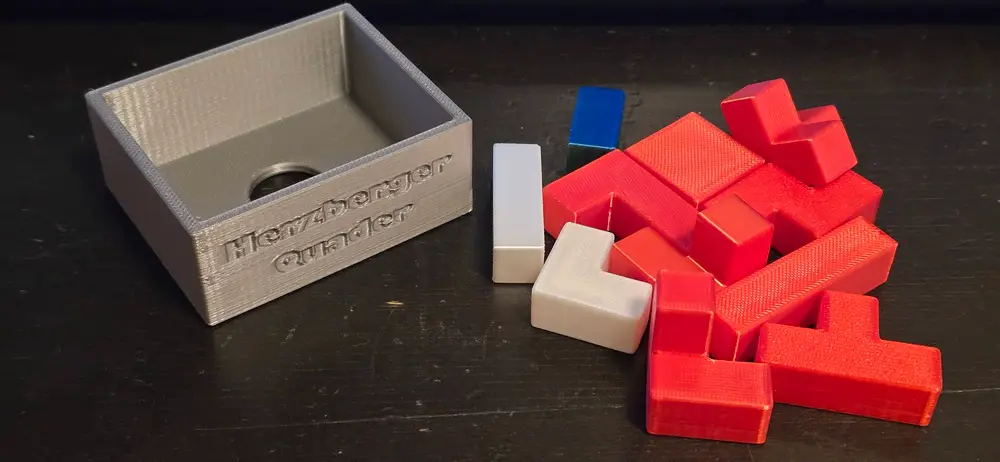
Herzberger Quader


Herzberger Quader
The Herzberger Quader (also known as SomaPlus) is a 3D mechanical dissection puzzle invented in 1984 by German mathematics teacher Gerhard Schulze, comprising all 11 possible polycubes of size 2, 3, and 4—specifically 1 dicube, 2 tricubes, and 8 tetracubes—for a total volume of 40 unit cubes. Expanding on Piet Hein's classic Soma cube (whose 7 irregular pieces are directly embedded within the set), all 11 pieces pack together into a primary $2 \times 4 \times 5$ rectangular cuboid while subsets of the pieces can construct 47 different cuboid sizes across more than 10.1 million solutions, making it both a rich combinatorial challenge and a popular tool in mathematics education for teaching spatial reasoning and parity-based impossibility proofs.